
Occupational Hazards
Local Control and Individual Rights in the Balance in Minneapolis

“My lands are where my people lay buried.” Crazy Horse, speaking of the Black HillsI try to imagine 3,000 armed federal officers roaming streets that I frequent, and all I can think of are the empty places through which I have trekked on my great walks around the old cities. The sections where factories are gone, storefronts are shuttered, most of the housing is demolished, and people are scrambling every day to meet their basic needs. Abandoned places lay bare the notion of “occupation”.
My great walk around St Louis in 2015 started in one of these forlorn areas, near the site of the Pruitt-Igoe public housing complex, just out of downtown. Yes, the dreaded public housing. Spanning 33 blocks, Pruitt-Igoe’s 33 high-rises entered the cycle of crime and abandonment within a decade of their 1954 opening, were demolished in 1972, and became a public policy case study in my graduate school curriculum in the 1980s. I wanted my loop around the city to include the great Mississippi River, historic Busch brewery, World’s Fair sites in Forest Park - and, yes, as much as anything, the area around the demolished Pruitt-Igoe housing.
I wanted to see how the community survived decades after the massive demolition. “Community” can’t really be held in the hand: it’s some kind of spirit whose sum is greater than the people and buildings that are part of it. People on their deathbed will rhapsodize the neighborhood they grew up in 70 years prior. What is this force? Who controls this force? Alot of different things, and different things to different people.
I found in the Pruitt-Igoe area a curator of two centuries of relics: a few Irish street names from their early 19th century arrival; some “shotgun shack” housing reflecting the city’s southern ties; two water towers that looked straight out of ancient Rome. I felt the heartbreak of losing everything as well as resilience to carry on, and it colored the sense of desolation that enveloped me. From others’ vantage points, danger and threat inhabit abandoned neighborhoods, so they chastised me for walking through. Multiple people seriously criticized my judgment. (Google photos in sequence below.)
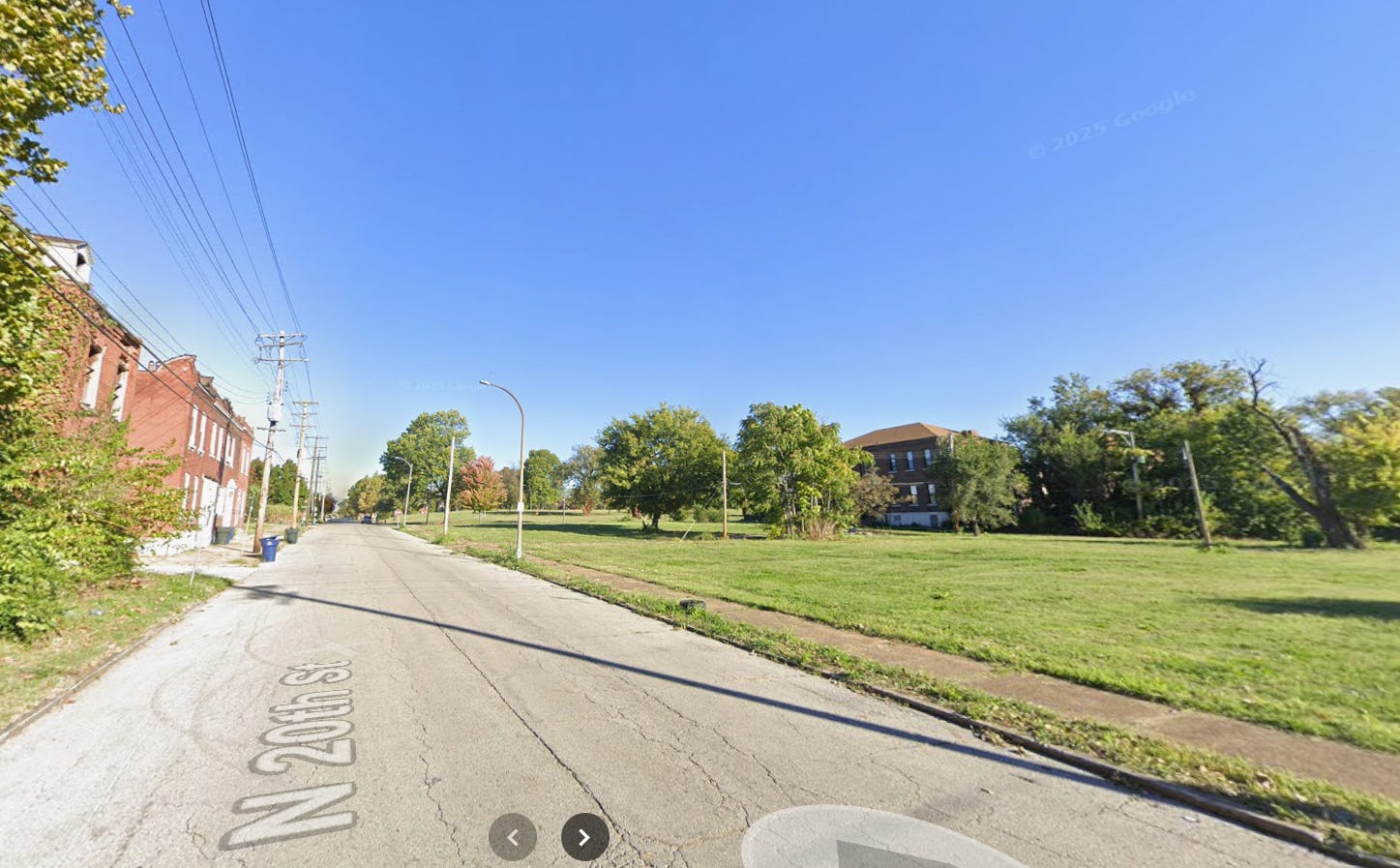
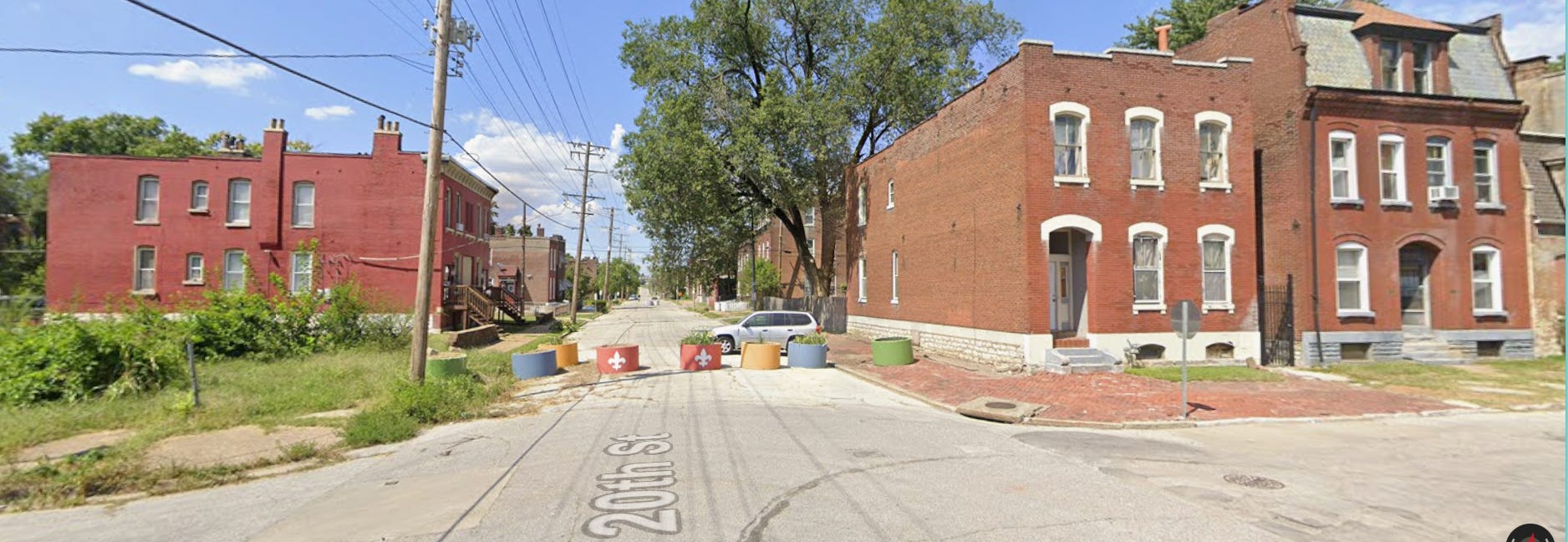
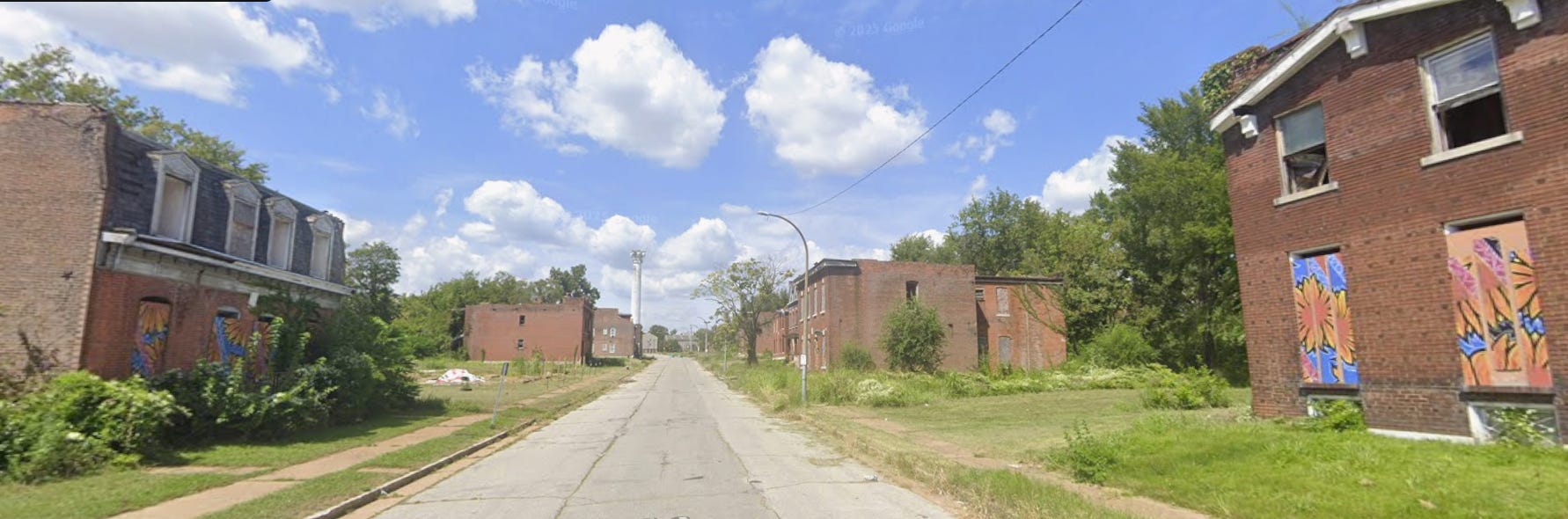
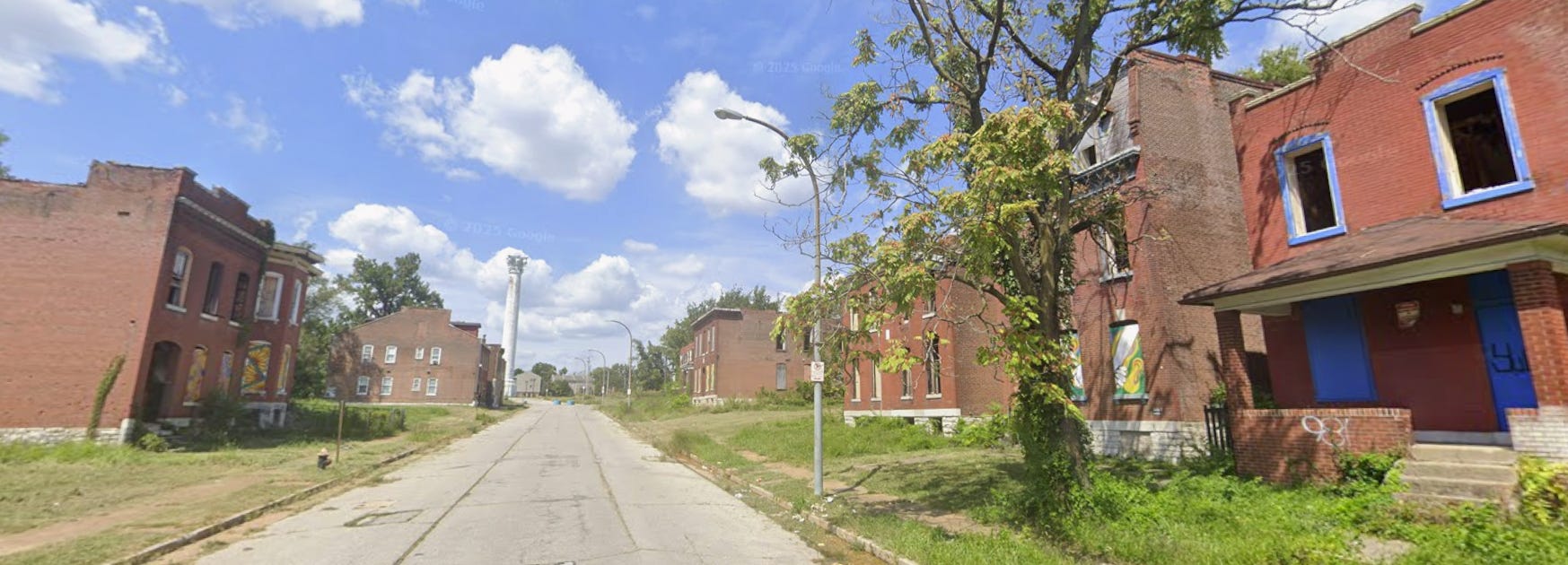
Who’s right? Both of us responded from our own feelings. I think it’s easy to sit in our own communities and pass verdict on others’. We try to define the presence or spirit of places as if that allows us to know what will happen if we go there. We delineate communities by the shopping corridor, factory, university, tourist attraction, family life, poor, or gangs that reside in them - often, by many of these.
Armed federal agents disrupt that organism. In a free society, no one is supposed to control spaces. We are each supposed to rise to a level of self-control needed to get along with others, so that there isn’t a need to restrain our freedoms beyond what we mutually agree upon with our neighbors. We give up some liberty (taxes; laws) in exchange for opportunity and security (according to Founding Fathers’ favorite, John Locke). Our commitment comes from accepting the terms of belonging.
The incomprehensible surge of federal ICE agents into Minneapolis, on the heels of incursions into Los Angeles, Washington DC, Chicago, and Portland, is a version of this transaction, albeit a bastardized one, in that nobody asked for and the majority and local leadership reject what is on offer. The surge is one of direct control - not solely social or economic influences. Initially totaling 2000 federal agents sent on the pretense of mass fraud among Minnesota Somalis, after an agent killed unarmed citizen Renee Good on January 7, instead of reviewing their policies and procedures - or the shooting itself - 1000 additional agents were sent.
For context, only 80,000 Somalis live in all of Minnesota, so the ratio of agents to the total universe of possible targets is about 1 to 20. All of South Minneapolis where the agents are said to be concentrated has 50,000 residents. The 3000 agents would represent 1 for every 16 or 17 of those residents - so they are likely visible on every block and interacting primarily with white citizens. This force is five times the entire Police force.
In history, American has dispatched military in response to specific events (civil unrest and labor strikes come to mind) but always in conjunction with local officials. Back to shared goals for which we give up some freedoms - the consensus is not there. Reports about the militarized agents on the ground reflect attack mode: warrantless and violent takings of people, even children, regardless of citizenship; weapons publicly brandished to innocent bystanders and Congresspersons exercising their right to visit detention centers; aggressive door to door invasions and cars rammed on the street. Injuries and attempts to escalate rather than tamp down conflict. Like the 2025 city turns, constitutional guarantees of due process and freedoms of speech and assembly are consistently violated and done so under the public statements of leadership. City and State government leaders are pleading for relief, and they have been frozen out of their own law enforcement such as investigating the killing.
By any definition, the federal government is an occupying force. How does this define the community?
I go back to that 2015 Saturday morning in the miles around the Pruitt-Igoe site. The blocks were by no means empty, but still, the area felt desolate to me. Losing 3000 housing units meant that nothing animated the streets I walked. A lone child sat on a curb and a man roamed aimlessly and that was it the whole time I was on the N. 20th street corridor. The one visible force of control were the makeshift planters blocking off through traffic (see photos), so I was free to carry out my strange little mission, regardless of whether it made sense to anybody. I was free to invest in its next transformation if I could gain the confidence of those already invested there.
In truth, control that cities and city residents have over their fate is threatened by globalization of the economy, competition between city and suburbs, and all sorts of negative assumptions about the people of color left in the wake of this dislocation. But their freedoms are otherwise intact. For now. Until the agents arrives to ask them for papers or attack them for being disrespectful.
These freedoms incentivize people to self-regulate, as our Founding Fathers knew. Why would we not support that? Passing through for an hour limits my perspective, obviously. I respect that people living there have different perspectives - and vested interests - than I. I know it’s for the greater good that they define community for themselves. Respect of each other is what we need to live up to the freedoms America is built on.
I often cite 19th century Lakota leader Crazy Horse when speaking of Detroit, thinking how the city has curated so much of my family’s history. But Crazy Horse’s legend comes out of his resistance to the federal government’s encroachment on even that land ceded to the Lakota nation. The US did not honor commitments to indigenous tribes in its march over the continent. Similarly, the long history of conflict between people and corporate interests has invariably ended with people losing, are then still being expected to support. The history of eminent domain under the guise of urban renewal shows this.
Occupations have hazards. Namely, that the system loses legitimacy in the eyes of the people whose compliance it needs to function. Abandonment has the same hazard: some will write off abandoned areas because of fear and distaste that the area has no order. Our country was founded on the government’s respect of individuals - on letting us control our own communities in order for the government to have legitimacy. Without the “Consent of the governed to be governed” that Locke espoused, everything we know falls apart.
Everything is so close to falling apart. Minnesotans beg their Governor to press Minnesota’s National Guard to fight the federal ICE agents. These weeks could become the first skirmish of civil war. Or, they could be the last hurrah of our tradition of local self-government.
America’s pluralism has always been a stew whose ingredients are our vastly different peoples, past and present. The stew may or may not appeal to you, but the promise of freedom is that you can always find - or create - a stew you like. If occupied cities threaten our freedom to choose how we live or who we live with, we have no incentive to be the best we can be. No government can control everyone.
I don’t know if this is merely subversion of the democratic process, or “urbicide” of the places that always vote in favor of democracy. All I know is that the old souls of Detroit, that the ghosts of America’s other old cities, know how desperately we the people must own our own communities. Minneapolis fights for us all.