
Big Empty Promises
Data Centers and Other Mega-developments That Transformed Towns

Among the big stories of this really big moment in our history is the push by corporations to reorient our society around artificial intelligence (AI). For all that AI can and might entail, I’m focused here on the construction of huge computer farms, everywhere, to power the computing capacity this super-sized technology requires.
I can’t fully fathom the societal transformation that awaits us - “await” being the proper term when it’s clear that the very richest people in the world will determine what form changes will take. I can’t fathom the specific social and economic consequences, though the growing political influence of “Tech Bro” barons suggests that AI will have a startling impact on our systems of governance. I can assume that it will move forward much as all previously unfathomable transitions did: with speed and with little community planning.
One of the biggest transformations to roil American communities was industrialization. Large scale investment in new machine age technologies took a rather interesting subset of towns on the country’s coasts and in the newly developed interior from pastoral walkable communities to massive metal and concrete monstrosities within one generation in the late 1800s. People who had spent their entire lives within a single square mile watched their children walk farther than that every day to work in complexes that were themselves often a square mile in size.
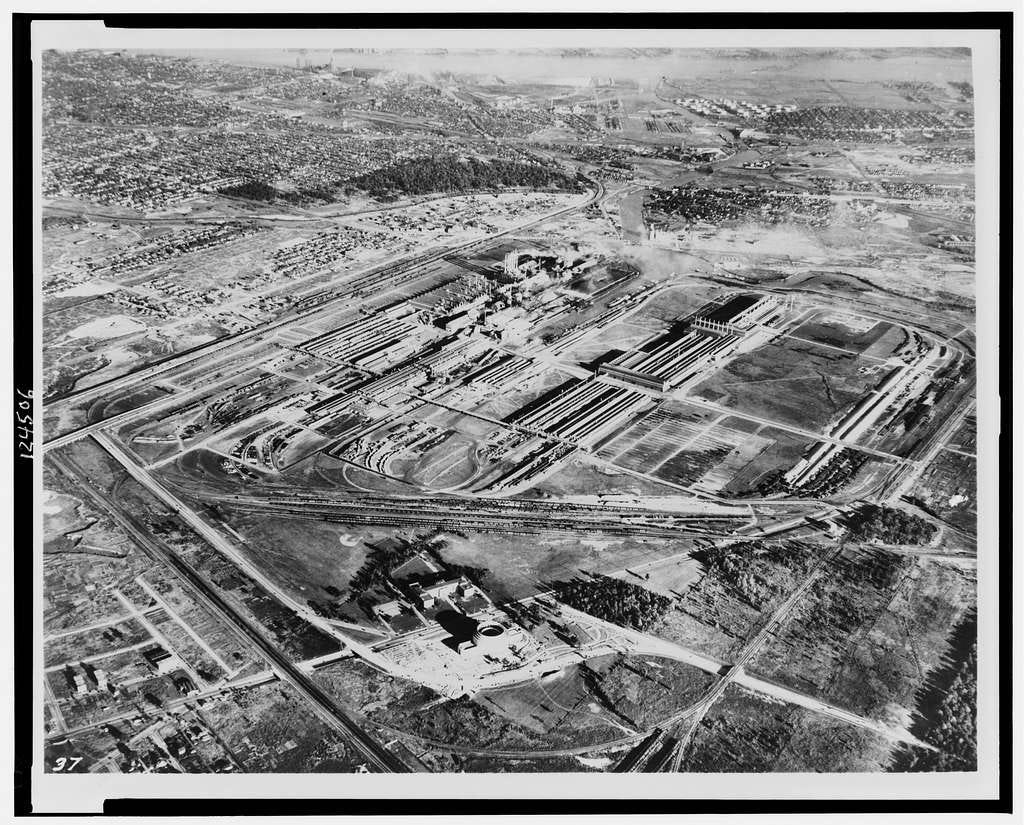
Are Data Centers Just Like 19th - early 20th century factories?
First: this concept of a computer farm, known popularly as a “data center”. Data centers are physical facilities that organizations use to house critical applications and data. A data center’s design is based on a network of computing and storage resources through which these applications and data pass. Key components include routers, switches, firewalls, storage systems, servers, and application-delivery controllers.(Cisco describes it well.)
Escalating battles in communities across the country make this the next “NIMBY” (“Not In My Backyard” battles about locations of toxic waste dumps or other land uses with noxious air or groundwater impacts). In Michigan, a joint venture of OpenAI, Oracle and Related Digital is advancing a $7 billion proposal for a 575 sq miles site in Saline Township. The proposal has been in dispute since October, with fevered opposition by nearby residents. Despite three 550,000 sq ft buildings, it only promises 450 jobs, as it’s largely hardware-based. Fully operational, it would spike demand on that DTE grid by 25%, which DTE says it can accommodate; people still worry that it might cause additional costly infrastructure requirements for DTE or water.
Data centers’ energy use most clearly reveals the collective aspects of these big developments. They are throbbing, pulsing rows and fields of 24/7 computing capacity, not unlike Detroit’s assembly lines or Pittsburgh’s fiery forges of a century ago. Communities need bigger infrastructure to support them.
Some people still argue that a company can build as it pleases if they have the funds. The Michigan Governor’s Office helped them find a site, and they boostered the announcement, eager to champion industries of the future in the wake of an eviscerated automotive base. Even with public subsidies such as finding land, sales and use tax exemptions on equipment, property tax abatements, and adjacent road and infrastructure construction, others argue that the new jobs are worth it. Data Center Watch, a security consultancy, tracked 20 projects (valued at $98 billion) that were rejected at the local level in eleven states in 2025 - 2/3 of all they tracked.
Everyone could be sitting in the dark more frequently, as power surges associated with this scale of energy use are likely to cause more frequent cascading blackouts. All of us sit under a dark shadow of fewer and fewer jobs that pay a living wage, and the storm clouds of vast deskilling of professions as a result of deployment of artificial intelligence enabled by these centers.
Data centers can disrupt regions in many ways beyond the land use islands they create, as Detroit, Pittsburgh and other old manufacturing centers were turned on their heads a century ago.
Was the Industrial Boom Controversial for 19th Century Townsfolk?
The answer depends on who you ask - and when you ask them.
When trains first found their ways into cities in the mid-19th century, residents decried the fires caused by shooting sparks and the hazards to pedestrians and horses. Even after cities made considerable investments for grade separation of rail from the streets, riots broke out in many a city (such as Gratiot Avenue business owners in Detroit in 1849) due to the hazards.
The Packard Motorcar factory on Detroit’s eastside was 80 acres when fully operational in 1904. Its innovative use of reinforced concrete to open up interior assembly space was revolutionary and a source of great pride that Detroit leaders used to recruit more investment. Detroit was “open for business” - innovators with the drive to reshape production throughout the world. Packard was constructed in a populated residential area and spurred considerable new residential and commercial units. I reflected on its’ demolition in this 2024 blog:
Ode to the Packard Plant

Look deep into darkness, and shapeless mounds may appear. These indiscernible forms linger in our subconscious, the last things we apprehend before the light fully evaporates. The old Packard Motor Company factory has been this kind of harbor for Detroit.
The next generation of auto factory, Ford Motor Company’s Rouge complex, built in the aftermath of World War I, is 2000 acres - a staggering 1.5 miles wide by 1 mile long, including 93 buildings with 16 million square feet of factory floor space. This is the size of several data centers. With its own docks in the dredged Rouge River, 100 miles of interior railroad track, its own electricity plant, and integrated steel mill, they turned raw materials into running vehicles there, pioneering vertical-integration.
Please understand, the Rouge complex employed nearly 100,000 at its 1920s peak. It employed 200 times as many people as the Saline data center is promising. Whole neighborhoods found their livelihood there - you could argue that the entire fortune of the city of Dearborn at Detroit’s west border was found through Ford. Detroit became an international icon due to the scale and might of the Rouge Complex.
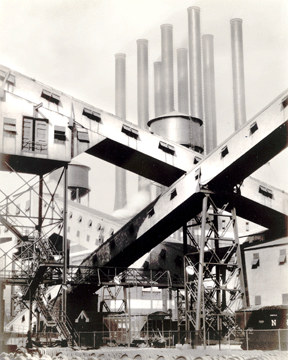
Building the Rouge meant abandoning the Highland Park Assembly Plant - which had left the Piquette Plant empty just a decade prior to its opening. According to the Detroit Historical Society, as of 2018, Rouge sits on only 600 acres and employs just 6000 people. It is a shell of itself, but it remains operational, unlike virtually all heavy manufacturers on the 20th century.
Where Is This All Going?
Where will these data centers take us? How will they affect the amount of built land and the scale of our infrastructure, and most of all, in what ways will they change our lives? Where is all of this “progress” taking us?
The long and winding policy discussion includes labor and capital, public and private investment shares, and local, state and federal roles - but I simply go back to the 19th and early 20th century mega-developments that shook those cities. Detroit’s Ford Rouge, Pittsburgh’s Jones and Laughlin Steel and Chicago’s Pullman Works all changed the size, shape and inner workings of those towns into something residents didn’t recognize, but outsiders poured into. Cleveland’s Cuyahoga River was so polluted that it caught fire in the Industrial Valley in 1969 - but it’s the model of environmental stewardship today.
Most of these places are physically erased - gone, like amputated limbs leaving deeply impaired cities and residents. In cities whose landscapes industrialization overwrote, the wind blows across jagged and infertile plains after the wealth they created was blown across the globe. Is that where this is going?
Interesting essay. The proposed data center in the Saline Mi area will be 575 acres, not 575 square miles. A bit of a difference.